Navigating Rising Additional Rents in 2026
Market Overview
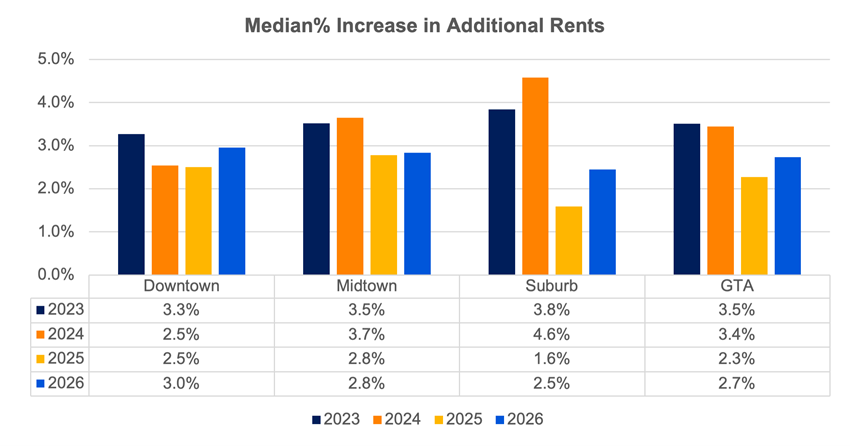
The additional rents are rising again. We are seeing a significant increase across the Greater Toronto Area, especially in downtown Toronto and the suburbs. After high figures in 2024 and a relief year in 2025, the numbers for 2026 are going back up.
In downtown Toronto, additional rents have jumped the most, currently sitting at 3.0%. One reason that can be attributed to the increase is the ongoing shift to quality. High-end buildings are offering more services and investing in technology, wellness features, and sustainable upgrades to encourage a stronger return to the office.
In the suburbs, we saw the largest year-over-year change among all areas, at 0.9%, bringing the overall increase to 2.5%. The rise in labour costs is also a major factor. Midtown has remained more stable, with additional rent generally matching last year’s figures.
Why It Matters to Tenants
In most net office leases, tenants pay base rent plus additional rent. While base rent remains fixed, additional rent is variable and can fluctuate with service levels.For example, if you pay $20 PSF in additional rent, a 4% increase means an extra $0.80 PSF. On a 10,000 SF lease, that is about $8,000 more per year, without any change to net rent. Over a five- or ten-year lease term, these increases can stack up, resulting in unexpected costs.
We are also seeing median additional rent estimates outpace inflation. In February 2026, the Consumer Price Index (CPI), excluding the effect of indirect taxes, rose 1.9% year-over-year. (Government of Canada, 2026)1
In a balanced market, these estimates should track closely with inflation, and when they exceed it, it often points to real changes in the building, as landlords may be recovering deferred costs from previous years or passing through management fees and capital recoveries more aggressively.
Lease expense reconciliations reflect these changes for tenants.
Key Factors Impacting Additional Rents in 2026
1. Return-to-office
Large employers and public-sector organizations have tightened in-office attendance requirements. For example, Ontario decided to bring its government workers back to the office five days a week starting in early January 2026. From a Lease Expense perspective, higher occupancy typically increases variable operating costs. Buildings operate HVAC systems for longer periods, and electricity and water usage rise. Cleaning schedules become more frequent, and security and concierge services may expand. These costs usually fall under operating expenses and are recovered through additional rent.
2. Insurance
While Canadian commercial property rates have begun to stabilize, these gains are being largely offset by rising liability pressures. Driven by inflation, increased claim severity, and litigation costs, the liability side is pushing expenses back up, keeping overall insurance premiums relatively flat.
3. “Green” operating efficiencies
Landlords are investing in energy-efficient systems, such as HVAC upgrades, LED lighting, and smart sensors, to lower long-term utility use and meet ESG goals. However, the capital costs for these retrofits are often recovered through Common Area Maintenance charges. In such a case, tenants should focus on the ‘tipping point’ where the actual energy savings begin to outweigh the amortized costs of these upgrades.
4. Tariffs and labour
Trade measures and ongoing tariffs on aluminum, steel, and copper are tightening supply chains, driving up the price of replacement parts and building equipment. When combined with a tight labour market in skilled trades, these factors are pushing costs higher for third-party services like janitorial, security, and mechanical maintenance, which directly affect additional rent.
Bottom Line
Additional rent is on the rise again in 2026, driven by multiple factors including return-to-office trends, insurance pressures, sustainability upgrades, and tariffs, all contributing to higher operating costs.
Tenants should closely monitor additional rent alongside base rent and consider initiating a Lease Expense Review to ask the right questions before any surprises arise. Reach out to Cresa Toronto for expert guidance to ensure accurate charges that align with your lease agreement.
Data Source: Cresa Toronto, CoStar
Note 1: Government of Canada, Statistics Canada (2026, March 16). Consumer price index, February 2026. https://www150.statcan.gc.ca/n1/daily-quotidien/260316/dq260316a-eng.htm
Related


.jpg)