Real Estate Trends in the Financial Sector
BANKING’S PROPERTY RESET:
How Industry Transformation is Reshaping Real Estate Strategies
The banking sector has experienced significant changes since the beginning of 2020. As Covid restrictions encouraged remote and hybrid work, employers in financial services adapted their approaches to how and where people work. While many smaller and larger banks are now requiring more in-office presence, with some mandating a full return to work, hybrid work arrangements have become the standard.
Due to this shift, banks have started adjusting their real estate strategies to focus on planning for peak occupancy rather than full occupancy. At the same time, the long-awaited AI revolution is beginning to take shape. While many roles in data processing, back-office operations, and customer service are being reduced, new job opportunities are emerging. It is still too early to fully understand how these new AI technologies will impact employment. Decisions regarding future employment and office space requirements are becoming increasingly complex.
As financial institutions adapt to changes in the market, their office real estate strategies are also evolving. While corporate offices are transforming to support hybrid work, collaboration, and specialized talent, traditional bank networks are either shrinking or being reimagined. These shifts are encouraging banks to reevaluate the size, location, and purpose of their real estate holdings.
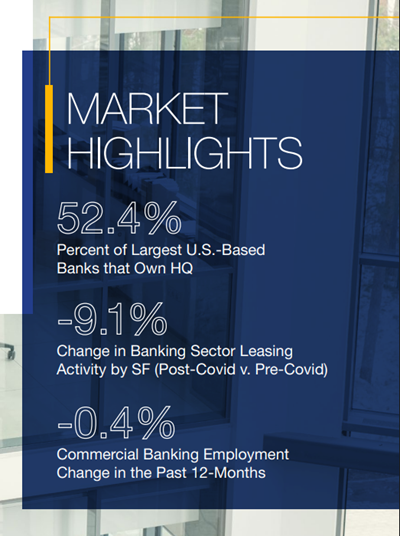
Banks are increasingly viewing real estate as an operational asset rather than merely an investment on their balance sheets. They are favoring leasing and sale-leasebacks for greater flexibility and capital efficiency while selectively owning locations that are critical to their operations.
Future of banking
The U.S. banking sector is expected to adjust its office and retail footprint rather than drastically reduce it in the coming years. While hybrid work arrangements and digital banking have reduced some space requirements, banks still rely heavily on physical offices and retail branches. This is especially true for headquarters and regional hubs, which are vital for collaboration, regulatory functions, and client-facing activities.
As a result, many institutions are consolidating older or redundant locations while investing in modern, high-quality spaces in major financial centers and growing markets such as New York, Charlotte, Dallas, and Miami. Moving forward, real estate strategies across the industry will likely emphasize efficiency, flexibility, and attracting talent. Banks will continue to maintain a significant office and retail presence but will increasingly focus on fewer, more strategic locations that align with their long-term operational and workforce needs.
Additionally, changes in job types will inevitably impact banking employment and, consequently, office and retail demand. Occupiers who are well-prepared and adaptable, with the ability to scale operations up or down, will be better positioned to adjust to these upcoming changes.
Download the full report for an in-depth view of the factors impacting the way occupiers in the financial sector are making real estate decisions.