Turn I-95 Corridor Market Choice into an Operating Advantage
The I-95 corridor connects some of the East Coast's most important industrial markets, US ports and distribution networks, supporting regional distribution and Northeast freight movement. But while these markets share a major transportation artery, they offer distinct advantages when it comes to occupancy costs, facility availability and access to customers.
Cresa's October 2026 I-95 Corridor Industrial Market Report examines industrial real estate conditions across Richmond, Baltimore, Philadelphia, New Jersey and New York, highlighting where occupiers are gaining negotiating leverage and what factors should influence location decisions.
With industrial availability elevated across the corridor and construction slowing in most markets, occupiers have more opportunities to evaluate alternatives. However, finding the right facility still requires balancing rental costs with transportation, labor, infrastructure and operational requirements.
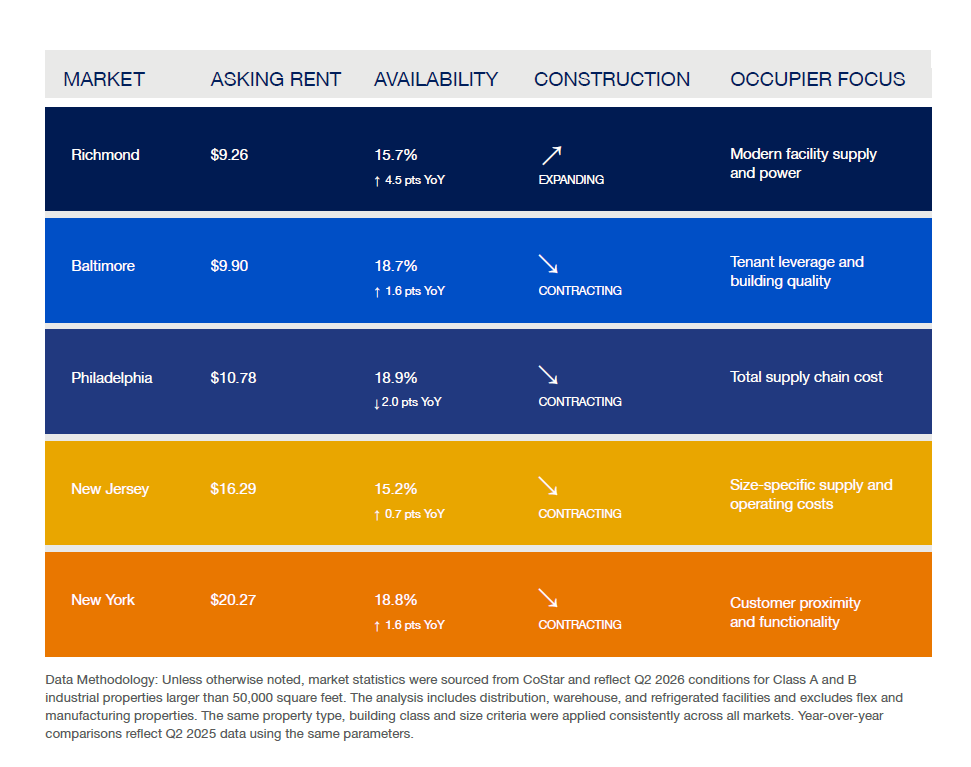
I-95 Corridor Industrial Market Comparison | Source: CoStar, Q2 2026. Class A and B industrial properties larger than 50,000 SF.
Industrial Real Estate Trends Along the I-95 Corridor
Several trends are shaping industrial real estate decisions across the region:
- Occupancy costs vary significantly. Average asking rents range from $9.26 per square foot in Richmond to $20.27 in New York, highlighting the importance of evaluating rental costs alongside transportation and operational needs.
- Availability is elevated across markets. Availability rates range from 15.2% in New Jersey to 18.9% in Philadelphia, giving occupiers more opportunities to compare properties and negotiate favorable lease terms.
- Construction activity is slowing. Development pipelines have contracted across Baltimore, Philadelphia, New Jersey and New York, while Richmond remains the exception with 5.4 million square feet under construction.
- Building functionality remains critical. Despite increased availability, facilities with adequate power, loading capacity, trailer parking and other specialized features remain limited.
Richmond Industrial Market: Lower Costs and New Construction
Richmond offers some of the lowest industrial occupancy costs along the I-95 corridor, with average asking rents of $9.26 per square foot. The market also leads the corridor in construction activity, with 5.4 million square feet underway in Q2 2026. While new supply is creating more options for occupiers, modern facilities with sufficient power and capacity for larger users remain limited.
Baltimore Industrial Market: Growing Tenant Leverage
Baltimore's industrial market is becoming more favorable for occupiers as availability increases and landlords offer greater concessions. With an availability rate of 18.7% in Q2 2026, companies have more opportunities to negotiate lease terms. However, aging inventory and limited modern facilities can complicate requirements for power, loading and clear height.
Philadelphia Industrial Market: Leasing and Availability Trends
Philadelphia leads the I-95 corridor in leasing activity and net absorption, with 7.7 million square feet of net absorption reported in Q2 2026. With an availability rate of 18.9% and average asking rents of $10.78 per square foot, the market offers occupiers a combination of regional distribution access, competitive costs and increased negotiating flexibility.
New Jersey Industrial Market: Port Access and Distribution
New Jersey's industrial market plays a critical role in Northeast distribution, offering extensive highway connectivity and access to the Port of New York and New Jersey. Average asking rents were $16.29 per square foot in Q2 2026, although costs and availability vary by location. North of Exit 8A, occupiers benefit from proximity to the port and New York City, while locations farther south offer comparatively lower occupancy costs and greater flexibility for certain space requirements. Evaluating these tradeoffs is essential when balancing transportation efficiency, facility requirements and total operating costs.
New York Industrial Market: Last-Mile Distribution and Costs
New York offers access to a dense consumer market but carries the highest average industrial asking rent along the corridor at $20.27 per square foot. While availability has increased, well-located facilities with adequate loading, parking and highway access remain scarce. For occupiers, the value of customer proximity must be weighed against higher real estate and operating costs.
Turn I-95 Corridor Market Choice into an Operating Advantage
Choosing the right industrial location requires more than comparing rental rates. Labor availability, transportation costs, port access, building functionality and long-term operational needs can all influence the total cost of occupancy.
Download Cresa's I-95 Corridor Industrial Market Report for detailed market comparisons, local advisor perspectives and insights to help inform your next lease negotiation, relocation or expansion decision.