The AI Legal Sector Trends Shaping Law Firm Jobs & Real Estate Decisions

Artificial intelligence is rapidly becoming one of the most significant forces reshaping the legal profession since the advent of electronic research databases. As conversations around AI and law continue to accelerate, law firm leaders are evaluating how AI can support attorneys, improve productivity, and reshape traditional legal workflows. While previous technology advancements focused on administrative efficiency, generative AI is directly affecting core legal work. The result is a restructuring of how legal work is performed, staffed, priced, and delivered.
How are law firms using AI?
Areas Impacted by AI Tools
- Legal research
- Brief drafting
- Contract review
- Due diligence
- Citation identification
- Due diligence
- Knowledge retrieval
- Document summarization
AI for Legal Research
AI for legal research has quickly become one of the most visible and practical applications of AI in law firms. These tools can help attorneys identify relevant case law, summarize legal documents, retrieve internal knowledge, and support early-stage analysis. However, because accuracy and citation verification remain critical, AI-assisted research still requires attorney review and professional judgment.
Staffing Impacts
Historically, law firms have used the following workflow, but AI may alter leverage models:

Recent hiring data indicates firms are increasingly favoring experienced lateral attorneys over entry-level lawyers, with legal technology cited as one contributing factor.
This shift in staffing raises important questions about: Associate training; Future partner pipelines; Summer associate programs; and Traditional apprenticeship models
Pressure on Billable Hours
Efficiency gains through the implementation of AI are creating tension with the traditional billable-hour model. For instance, a task that may have taken 10 hours of an associate’s time can now be completed in 25% of the time with the assistance of AI. A report by Thomson Reuters1 has suggested that AI may accelerate a shift toward:
- Value-based pricing
- Fixed fees
- Outcome-based fees
- Subscription legal services
Competitive Differentiation
Leading law firms are transitioning from viewing AI merely as a tool to recognizing it as a strategic asset. This shift requires strong support from leadership and substantial financial investments from the firm. For example, the top-ranked Am Law firm Kirkland & Ellis has announced plans to invest approximately $500 million in developing proprietary AI capabilities aimed at capturing and leveraging the firm’s institutional knowledge. While few firms can afford such significant investments, those that fail to adopt and invest in AI technology risk falling behind in the rapidly changing legal landscape.
True competitive advantage may increasingly come from combining proprietary legal expertise with AI systems. For many firms, the focus has shifted from whether AI has a role in law to how AI in law firms can be implemented responsibly, governed effectively, and scaled across the organization.
Below are a few examples:
- Internal legal knowledge engines
- Firm specific AI models
- AI-enhanced document repositories
- AI-powered client service platforms
Risks, Ethics, and Professional Responsibility
While the legal industry has significant potential for AI to greatly enhance efficiency, it also encounters risks associated with the early adoption of new technologies. The largest obstacle to AI adoption is its reliability. Numerous incidents have led courts and regulators to issue warnings about issues such as fabricated citations, hallucinated case law, incorrect legal analyses, and concerns regarding confidentiality. These challenges emphasize the need for attorneys to take responsibility for verifying all work generated by AI.
As a result, law firms are establishing guidelines and policies to hold lawyers accountable for their use of AI tools.
Law firms are embracing AI, but adoption is occurring within increasingly rigorous governance frameworks designed to protect client confidentiality, maintain professional standards, and ensure human accountability for all legal advice and work product.
A model that is becoming increasingly relevant for the responsible use of AI in law firms is the "human-in-the-loop" (HITL) framework. This approach emphasizes that while AI can assist with legal tasks, it is essential for a lawyer to review, validate, and ultimately take responsibility for the final work product. This principle is supported by ABA Formal Opinion 512, court guidance, state bar ethics opinions, and the internal policies of law firms regarding AI usage.
Law firms are progressively establishing AI oversight committees, implementing mandatory training programs, and developing written guidelines that address critical issues such as privilege, confidentiality, accuracy, citation verification, and professional responsibility.
In addition, cybersecurity and data protection have become as crucial as accuracy and ethics in law firms' AI strategies. Many firms restrict the use of public AI tools for client matters unless specific approval is granted. Additionally, firms are adopting technologies that prevent attorneys from uploading privileged documents, personally identifiable information, or confidential client data into authorized AI systems.
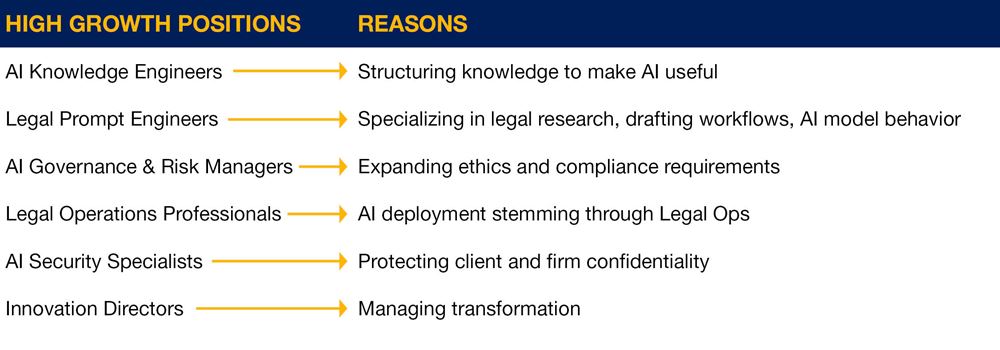
New Positions Being Created by AI Adoption
An outcome of AI integration in the legal profession is the entirely new roles being created, while also transforming traditional legal operations. Firms are building multidisciplinary teams that combine legal expertise, technology, cybersecurity, data governance, and innovation.
How will AI affect the legal field?
What The Experts Are Saying
Thomson Reuters (2025) – The Thomson Reuters Institute has found that the adoption of generative AI in the legal profession is growing rapidly, with firms progressing from experimentation to implementation. Their research indicates that legal professionals primarily view AI as a productivity tool rather than as a replacement for lawyers. According to their 2025 report, estimates suggest that lawyers could save nearly 240 hours per year through AI-assisted workflows.1
ABA Legal Technology Survey – The ABA’s Legal Technology survey found significant growth in AI adoption among law firms, particularly larger firms. The survey highlights increasing use of AI-driven legal research and document review tools as part of broader digital transformation efforts.2
LexisNexis Industry Report (2025) – LexisNexis reported a strong acceptance of generative AI among professionals, with more than 80% of respondents indicating their willingness to adopt AI. Nearly three-quarters expressed confidence in AI’s capabilities. The survey revealed that over 50% of respondents saved one to two hours per day using generative AI, while 30% reported savings of three to four hours, highlighting a clear return on investment.3
Bloomberg Law – The Bloomberg Law State of Practice Survey Report indicates that the adoption of AI is accelerating; however, concerns regarding confidentiality, ethics, and risk management continue to be significant barriers.4 Additionally, another Bloomberg survey revealed that approximately 63% of attorneys reported using AI in some capacity at work.5 A recent article titled "We Trained 3,000 Layers in Generative AI. Here's What We Learned" highlights that firms are increasingly shifting from experimentation to structured deployment, supported by training and governance.6
Bringing It Together
A consistent message emerges from many of these reports and articles: AI is being adopted as a force multiplier for lawyers, not as a replacement for legal judgement. While the discussion around AI replacing lawyers continues to draw attention, current adoption patterns suggest that AI and lawyers are more likely to work together through supervised, human-led workflows. The industry’s focus has shifted from “Should we use AI?” to “How do we govern AI, protect client data, maintain ethical standards, and gain a competitive advantage from it?”
Many large firms are investing in proprietary systems, AI governance teams, knowledge engineers, and cybersecurity controls while maintaining strong human oversight of client-facing work. Smaller firms face a different challenge than Am Law firms. Most do not have the resources to build proprietary AI platforms, hire AI governance teams, or employ dedicated cybersecurity professionals. As a result, their approach is generally focused on controlled adoption, vendor reliance, and policy discipline rather than technology ownership, often using public AI tools directly, embedded with trusted legal technology platforms.
AI Impact on the Legal Sector’s Real Estate Decisions
The legal industry is distinguishing itself in the overall recovery of the office real estate market following the easing of pandemic restrictions. Law firms have returned to the office more quickly and in larger numbers than many other sectors. While office space reductions across various industries have typically ranged from 15% to 20%, law firms have generally maintained their space requirements both before and after the COVID-19 pandemic. Our findings indicate that decisions regarding office space have tended to be highly specific to each firm.
Although the legal industry has swiftly adopted AI, this has not yet influenced recent real estate decisions. As there may be unanticipated circumstances, predicting the future impact of space decisions is challenging. Nevertheless, it is important to note that these decisions will be strongly influenced by the size of the firm and its available resources.
For law firms, AI is expected to have a meaningful yet gradual impact on office footprints. Unlike many technology companies, law firms continue to prioritize mentorship, training, collaboration, business development, and client interaction, all of which benefit from in-person environments.
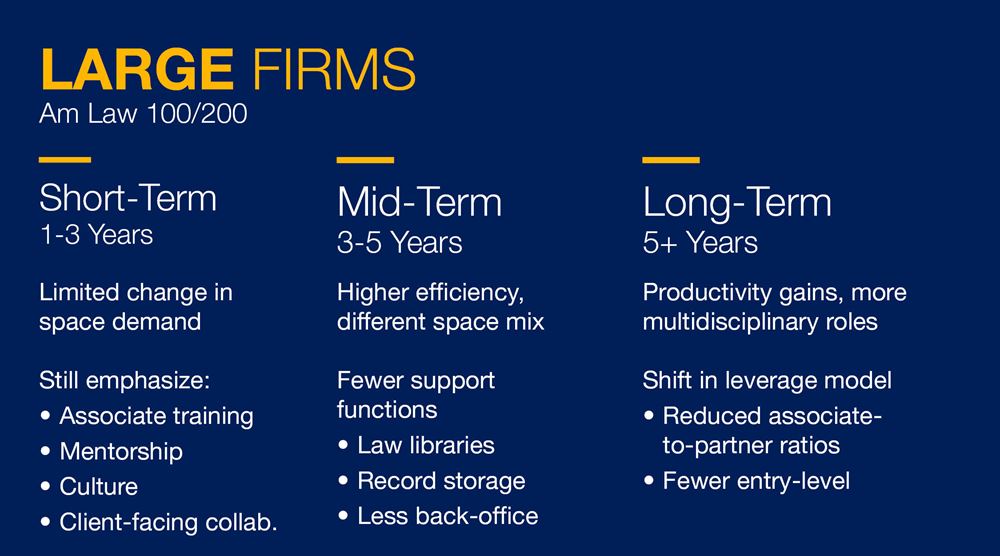
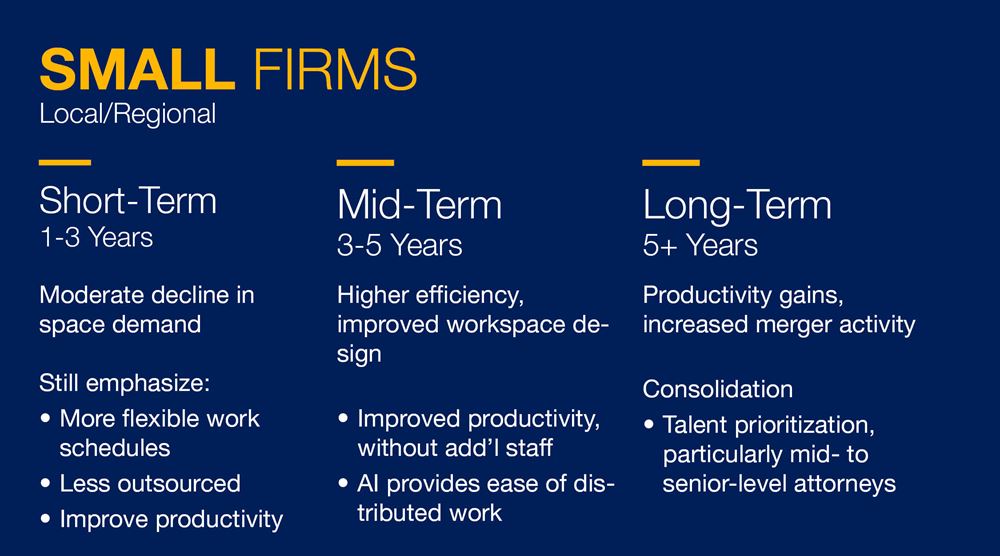
Artificial intelligence is not expected to lead to a near-term decrease in the demand for office space among law firms. Instead, AI is poised to transform the way legal work is conducted, enhancing attorney productivity and emphasizing the importance of collaboration, mentorship, and client engagement. Large firms are likely to continue investing in high-quality office environments that attract talent and foster innovation, while smaller firms may leverage AI to improve efficiency and manage future growth in office space. Over time, the most significant impact on real estate may arise from changes to traditional staffing and leverage models, rather than from remote work or direct reductions in office space.
From the perspective of office occupiers, AI acts as an accelerator for existing trends in law firm workplaces. These trends include a flight to quality, the creation of more efficient and high-performing office layouts, increased collaborative space, and greater investment in technology infrastructure. It is still uncertain whether headcounts will decrease, or if the anticipated efficiencies will allow firms to scale up. Additionally, there may be an increase in roles specifically related to technology and cybersecurity.
For more information on how industry trends are driving change in law firm workspaces, see our latest report on the legal sector.
Footnotes
- Thomson Reuters Institute, 2026 AI in Professional Services Report (Thomson Reuters, February 9, 2026), thomsonreuters.com.
- American Bar Association, The Legal Industry Report 2025 (American Bar Association, April 28, 2025), https://www.americanbar.org/groups/law_practice/resources/law-technology-today/2025/the-legal-industry-report-2025/.
- LexisNexis Legal & Professional, 2025 Future of Work Report (LexisNexis, February 11, 2025), https://www.lexisnexis.com
- Bloomberg Law. 2025 State of Practice Survey Report. Arlington, VA: Bloomberg Industry Group, 2025. Accessed June 2, 2026. Bloomberg Law State of Practice Survey Report
- Bloomberg Law. “Generative AI in Legal Practice: Who's Using It and How?” Bloomberg Law Analysis. Accessed June 2, 2026. Bloomberg Law Analysis – Generative AI in Legal Practice
- Bloomberg Law. “We Trained 3,000 Lawyers in Generative AI. Here's What We Learned.” Bloomberg Law Legal Exchange. Accessed June 2, 2026. Bloomberg Law Legal Exchange – We Trained 3,000 Lawyers in Generative AI
Additional Sources: CoStar and Cresa
Related